The best corporate gifts are not louder logos; they are useful, workplace-safe, recipient-aware upgrades that feel chosen rather than bulk-dumped. Start with the person, the occasion and the risk level, then choose a practical helper, a shared activity, a desk-friendly novelty, a budget-safe treat or a more personal adjacent gift if they already own the obvious gadget.
Corporate gifting gets awkward when the gift says, "We had a box to tick," instead of, "We noticed what would actually make your day easier." A branded pen has its place. Somewhere. Possibly in a drawer with seventeen other pens, a conference lanyard and a mystery USB from 2014. But if you want staff, clients, suppliers or event guests to remember the gesture, the gift needs a reason to exist in their real life.
Use this guide as a decision map rather than a generic list. If you already have a rough direction, browse LatestBuy's broader gift discovery page or compare more curated ideas through the gift guide collection. If you are still staring at a spreadsheet of names and hoping it will whisper gift wisdom, begin here.
Start with the corporate gift decision, not the object
Before choosing the gift, decide what job it needs to do. A corporate gift can thank, welcome, celebrate, retain, apologise, impress, include or simply make a long workday less beige. Each job points to a different level of usefulness, personality and risk.
A client thank-you should usually be polished and broadly appropriate. A staff milestone gift can be more personal. A conference giveaway needs to survive being packed in a tote bag with brochures and snacks. A team celebration can be more playful because it is shared, not silently judged at someone's desk.
Use this quick filter before browsing:
| Gift decision | Details |
|---|---|
| Thanking clients |
Best-fit direction: Practical, polished, easy to use Avoid: Anything too personal, cheeky or hobby-specific |
| Staff recognition |
Best-fit direction: Useful upgrade with a touch of personality Avoid: Generic swag that feels like office supplies |
| Event giveaways |
Best-fit direction: Compact, memorable, low-friction Avoid: Bulky items, fragile pieces, complicated setup |
| Team celebration |
Best-fit direction: Shared activity, game or desk-friendly fun Avoid: Gifts that exclude non-drinkers, families or remote staff |
| New starter welcome |
Best-fit direction: Everyday workday helper Avoid: Inside jokes they do not know yet |
| End-of-year gifting |
Best-fit direction: Broadly enjoyable, budget-consistent Avoid: One-size-fits-all novelty with no practical use |
The trick is to choose a lane before choosing the item. "Something cool" is not a lane; it is a tiny gift-buying fog machine. "A desk-friendly upgrade for hybrid workers" is a lane. "A group activity for a team lunch" is a lane. "A small budget gift that does not look like panic" is also a lane, and a noble one.
Practical gifts work when they improve the workday without shouting about it
Practical corporate gifts do not have to be dull. The useful gift becomes memorable when it solves a tiny recurring annoyance: cold coffee, cable chaos, poor desk comfort, travel clutter, flat batteries, messy drawers or the daily hunt for something that was definitely right there a minute ago.
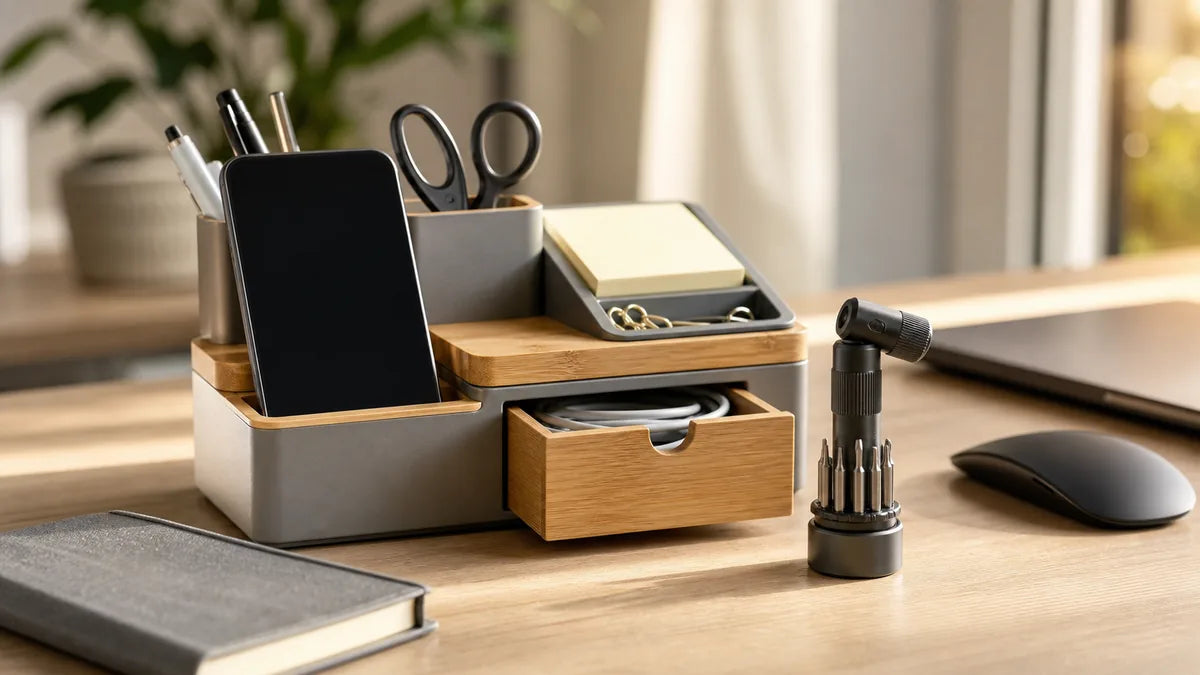
This is where gadget-adjacent gifts can shine. Instead of handing over the basic gadget everyone already has, look for the more personal or useful adjacent upgrade. If they already own a charging cable, consider a desk organiser, gadget accessory, travel tech helper or small electronics support item. If they already have a mug, think about a drink-related desk helper or a more interesting cup-style upgrade. The gift should feel like a nudge towards an easier routine, not another object demanding attention.
Good practical corporate gift directions include:
- Desk and workspace helpers for office, hybrid or home-office recipients
- Small tech accessories for people who commute, travel or present often
- Drinkware and coffee-adjacent items for daily desk rituals
- Travel and organisation helpers for field teams, sales reps or frequent flyers
- Kitchen or lunchroom-friendly items for shared workplace use
- Simple electronics or gadget support for recipients who like clever utility
If your recipients enjoy clever gear, start with gadget gifts and compare options by how often the person would use the item. For more tech-leaning teams, electronics and gadgets can be a better route when you want something practical but still a little "ooh, that's handy".
The safest practical gift test is simple: can the recipient understand the use case in five seconds? If yes, excellent. If it needs a demonstration, a charging ritual, three spare parts and an enthusiastic intern to explain it, maybe save it for the gadget enthusiast rather than the whole client list.
Fun corporate gifts need a reason beyond "it made us laugh"

Novelty gifts are not the enemy. Random novelty gifts are. The difference is relevance. A funny desk item, unusual mug, retro-style toy, mini game or playful office object can work beautifully when it matches the recipient, the workplace culture and the occasion.
The goal is not to make the gift the loudest thing in the room. It is to create a little spark: a "where did you find this?" moment that does not become an HR case study. For corporate settings, keep the humour public-safe, inclusive and easy to ignore if the recipient is having a very serious Tuesday.
Choose playful gifts when:
- The relationship is warm or long-standing
- The recipient's personality is known
- The gift will be opened in a casual setting
- The humour is visual, clever or nostalgic rather than rude
- The item still has some use, display value or activity value
Skip playful gifts when the recipient is new, senior, very private, highly formal or part of a mixed group where standards vary. A cheeky gift that works for one colleague may feel painfully off for another. Corporate gifting is not the place to test whether the accounts department enjoys chaos goblin energy.
A good replacement-logic move is to choose the adjacent personal version of a basic gift. If they already have standard office stationery, choose a clever desk toy, puzzle or conversation-starting object. If they already have a plain mug, choose something with a more distinctive shape, use case or theme. If they already own the standard gadget, choose the accessory that makes it more useful.
Activity-led gifts are excellent when the gift is really about connection
For teams, departments and client events, an activity gift can beat another individual item. Games, puzzles and shared activities are especially useful when the occasion is social: end-of-year lunches, team offsites, onboarding sessions, staff rooms, office break areas or family-friendly workplace events.
The advantage is that the gift becomes a moment, not just a thing. A compact game can sit in a lunchroom. A puzzle can live in a team space. A family-friendly activity can be taken home after a company event. This path is particularly helpful when you are buying for a group with mixed ages, roles, hobbies and levels of "please don't give me more clutter".
Consider activity-led corporate gifts for:
- Team celebrations where people will interact on the day
- Workplaces with shared break areas
- Remote teams receiving a small "switch off" gift
- Client workshops where you want something light but not disposable
- Family days or inclusive social events
- Staff appreciation gifts that do not require knowing everyone's personal style
For this lane, browse family games when you want something accessible rather than hyper-competitive. The word "family" is useful here because it usually signals broader suitability: less intimidating, easier to explain and more likely to work across different personalities.
The main risk is choosing a game that is too long, too niche or too complicated. Corporate activity gifts should be quick to understand and easy to join. If the rules need a committee meeting, you have accidentally bought a project.
Budget-friendly corporate gifts can still feel considered
A smaller budget does not doom you to sad desk clutter. It simply means the gift needs a sharper job. Under a tighter budget, avoid trying to look expensive. Instead, aim for clever, useful, compact or surprisingly specific. A well-chosen small item often beats a bigger item that feels flimsy, irrelevant or suspiciously like leftover event stock.
Budget-friendly corporate gifting works best when you group recipients by use case rather than trying to personalise every item. For example, choose one practical desk lane for office staff, one activity lane for team events and one polished small gift lane for client follow-ups. This keeps the buying process manageable without turning everyone into a row in a gift spreadsheet of doom.
Useful budget filters:
- Will the recipient immediately know what it is for?
- Is it easy to store, carry or display?
- Does it avoid size, taste and personal-style risk?
- Would it still make sense without a logo?
- Can it suit the occasion without feeling too intimate?
- Is it better as part of a small bundle or on its own?
If you need smaller spend options, start with gifts under $30 and sort mentally by recipient fit rather than novelty alone. The strongest low-budget gifts usually have one clear reason: desk helper, coffee break, pocket gadget, simple game, kitchen drawer hero or light-hearted conversation starter.
Do not apologise for a modest gift by making it excessively branded. A smaller item with a practical job often feels more generous than a logo-covered object that exists mainly to advertise the giver. People remember usefulness. They also remember weird pens, but not always fondly.
Match the gift to the recipient without over-personalising

Corporate gifts sit in a strange middle zone. Too generic and they feel forgettable. Too personal and they feel like you have been studying someone's calendar with binoculars. The sweet spot is recipient-led but not invasive.
Think in groups: role, routine, occasion and relationship. A remote worker may appreciate desk comfort or home-office utility. A field rep may suit travel or car-friendly organisation. A client contact may need something polished and low-risk. A creative team may enjoy playful desk objects or activity gifts. A long-serving employee may deserve something with more personality or keepsake value.
Here is a practical recipient-fit map:
| Recipient type | Details |
|---|---|
| New client contact |
Gift lane to consider: Polished practical gift Safer fallback: Broad gift guide browse path |
| Long-term client |
Gift lane to consider: Practical upgrade with subtle personality Safer fallback: Desk, drinkware or travel helper |
| Whole office team |
Gift lane to consider: Shared game or breakroom item Safer fallback: Family-friendly activity |
| Remote employee |
Gift lane to consider: Home-office helper or desk comfort item Safer fallback: Gadget accessory or compact organiser |
| Event attendee |
Gift lane to consider: Compact useful novelty Safer fallback: Small budget-friendly item |
| Senior stakeholder |
Gift lane to consider: Understated practical gift Safer fallback: Quality everyday utility |
| Creative or informal team |
Gift lane to consider: Playful desk item or puzzle Safer fallback: Useful novelty with no risky humour |
| Hard-to-read recipient |
Gift lane to consider: Top-selling or broadly practical gift Safer fallback: Safe fallback category |
For a mixed or uncertain recipient list, top-selling gifts can act as a confidence check. Not because popularity makes an item magically right for everyone, but because it can help you see gift directions other shoppers are already considering. Use it as a filter, not a crystal ball.
The "already has it" problem is common in corporate gifting. If they already have the basic desk gadget, choose the adjacent upgrade. If they already have standard drinkware, choose a coffee or tea helper. If they already have lots of desk décor, choose something consumable, compact or activity-based. If they already receive company merch every quarter, please, for the love of tidy drawers, choose something that works without a logo.
Use a risk filter before you buy in bulk
Bulk gifting magnifies small mistakes. One slightly odd gift is a curiosity. Two hundred slightly odd gifts are a procurement incident with bubble wrap. Before committing, run the idea through a risk filter.
Corporate gifts should usually avoid assumptions about religion, alcohol, politics, health, body size, gender stereotypes, relationship status, parenting status and niche hobbies unless you genuinely know the recipient group. It is also worth considering whether the gift will be opened publicly. A gift that is fine in a private parcel may feel awkward in a room full of colleagues.
Use this checklist before ordering:
- Workplace appropriateness: Would this be fine on a desk, in a staff room or at a client meeting?
- Recipient fit: Does it suit the person's role, routine or occasion?
- Relationship level: Is it too personal for a client or too bland for a milestone?
- Setup risk: Does it need batteries, space, tools, apps, sizing or technical confidence?
- Cultural and humour safety: Is the joke inclusive and low-risk?
- Storage and clutter: Is it compact enough to keep, carry or take home?
- Duplicate risk: If they already own the basic version, is this a better adjacent upgrade?
- Branding restraint: Would the gift still feel useful if the logo were removed?
Setup and compatibility matter more than many buyers expect. A clever electronic item might be great for a small tech-savvy team but risky for a broad client list. A game might be brilliant for a team lunch but wrong for a formal executive thank-you. A display item might suit a fan or collector but become clutter for a minimalist. The gift is not just the item; it is the friction around using it.
Build a corporate gifting shortlist in three lanes
The easiest way to avoid branded-pen syndrome is to create a shortlist with three different gift lanes: safe practical, fun surprise and shared experience. This gives stakeholders a real choice without letting the process sprawl into 97 tabs and a mild identity crisis.
| Shortlist lane | Details |
|---|---|
| Safe practical |
Best for: Clients, broad staff groups, new starters What to look for: Desk utility, travel helper, drinkware-adjacent item, compact gadget support Watch out for: Too plain, too logo-heavy, too close to office supplies |
| Fun surprise |
Best for: Warm teams, informal clients, milestone moments What to look for: Clever novelty, nostalgic object, playful desk item, puzzle Watch out for: Humour that is too niche, rude or hard to explain |
| Shared experience |
Best for: Team events, offices, workshops What to look for: Games, group activities, breakroom-friendly items Watch out for: Long rules, competitive intensity, exclusion risk |
This three-lane approach also helps with approvals. Instead of asking, "Which corporate gift should we buy?" you can ask, "Do we want safe practical, fun surprise or shared experience?" That question is far easier for managers, HR, marketing and admin teams to answer.
Once the lane is chosen, browse with intent. Use LatestBuy's curated gift guide to compare different directions, then narrow based on the recipient group, occasion pressure and budget comfort. If you need a broader starting point for mixed lists, the main gifts page can help you move from "no idea" to a workable category path.
Corporate gift ideas by occasion pressure

Occasion pressure changes the gift. A last-minute client thank-you needs a safer decision than a carefully planned staff milestone. A conference giveaway needs portability. An end-of-year gift needs broad appeal and budget control. A new starter gift needs usefulness without too much personality.
For client thank-yous, choose practical items with a polished, low-risk feel. Think desk, travel, drinkware or useful everyday objects. Avoid anything that assumes humour, fandom, alcohol preference or home décor style unless you know the person well.
For employee recognition, you can go more personal. A gift related to how they work, relax or contribute can feel more thoughtful than generic corporate merch. If the employee is known for being the office problem-solver, a clever utility gift may land well. If they help bring the team together, an activity or game might feel more aligned.
For events and conferences, portability matters. Compact, durable and immediately understandable gifts are your friends. Avoid fragile items, large boxes or anything that requires a long explanation at a booth.
For team celebrations, shared fun can work better than individual objects. A game, activity or breakroom-friendly item gives people something to do together and reduces the pressure of matching every single personal preference.
For end-of-year gifting, consider mixed recipient lists carefully. Segment by relationship if possible: clients, staff, suppliers and event partners may need different lanes. Consistency is good; identical gifts for wildly different relationships can feel lazy.
Short FAQ: corporate gift ideas without the pen-shaped sigh
What are good corporate gift ideas that are not branded pens?
Good corporate gift ideas include practical desk helpers, gadget accessories, drinkware-adjacent items, travel organisers, games, puzzles, useful novelties and compact everyday upgrades. Start by matching the gift to the recipient's routine and the formality of the relationship. A strong option should make sense quickly, feel workplace-safe and still be useful if no logo or branding is added.
How do I choose corporate gifts for people I do not know well?
Choose low-risk practical gifts with broad use cases, such as desk utility, travel organisation, simple gadget support or breakroom-friendly items. Avoid humour, sizing, alcohol, strong personal style and niche hobbies unless you have clear recipient knowledge. If you are buying for a mixed list, group people by role, occasion or routine rather than trying to personalise every gift.
Are novelty gifts appropriate for corporate gifting?
Novelty gifts can work well when the relationship is warm, the humour is inclusive and the item still has a clear use, display reason or activity value. Keep jokes public-safe and easy to understand. For formal clients, senior stakeholders or mixed workplace groups, choose clever, nostalgic or practical novelty rather than anything rude, divisive or overly personal.
What should I buy if someone already has the basic gadget?
Choose an adjacent upgrade rather than a duplicate. If they already have the standard gadget, look for accessories, organisers, desk helpers, travel cases, drinkware helpers or practical add-ons that make their existing item easier to use. This approach feels more considered because it supports the recipient's routine without assuming they need another version of something they already own.
Browse with a gift lane, not a panic tab
A corporate gift does not need to be expensive, flashy or covered in branding to be memorable. It needs to make sense. Choose the lane first: safe practical, fun surprise or shared experience. Then filter by recipient fit, occasion pressure, budget comfort and risk.
If you are ready to build a shortlist, start with LatestBuy's gift guide collection, compare practical options through gadgets, check budget-friendly ideas under gifts under $30, or use top-selling gifts as a confidence check. Follow the path that matches the person, not the nearest box of branded pens.
For the next browse step, compare the fit against electronics and gadgets and Family Games.