For most shared waiting areas, individual-use activity books and pads are the strongest starting point: quiet, easy to pause and usable without another visitor joining in. Non-electronic drawing boards come next for reusable creative play, followed by compact solo puzzles and then card games.
That order ranks reception practicality - not how much fun something is around the kitchen table. A brilliant game can become a surprisingly poor waiting-room companion if it needs four players, a lengthy explanation and someone keeping score.
The right choice should fit your visitors, the space and the time your team can spend maintaining it. Here's how the four approaches compare, where each earns its place, and when to change the order.
1. Activity books and pads: best overall for stop-start waits
Activity books and pads take first place because they suit the defining feature of a waiting area: nobody quite knows when the activity will end. Visitors can colour part of a picture, tackle a maze or begin a word puzzle, then stop when called. There is no game to abandon and no opponent left holding the cards.
They also offer useful variety within a small footprint. A family-focused reception might provide simple picture activities alongside more detailed puzzles for older children. An adult-facing office could favour word searches, visual challenges or drawing prompts with an age-neutral presentation.
The trade-off is replenishment. Paper activities are consumables, and writing tools need checking. A communal book full of completed pages is not much of an invitation.
Choose the format deliberately:
- Individual booklets give each visitor their own activity, but require ongoing supplies.
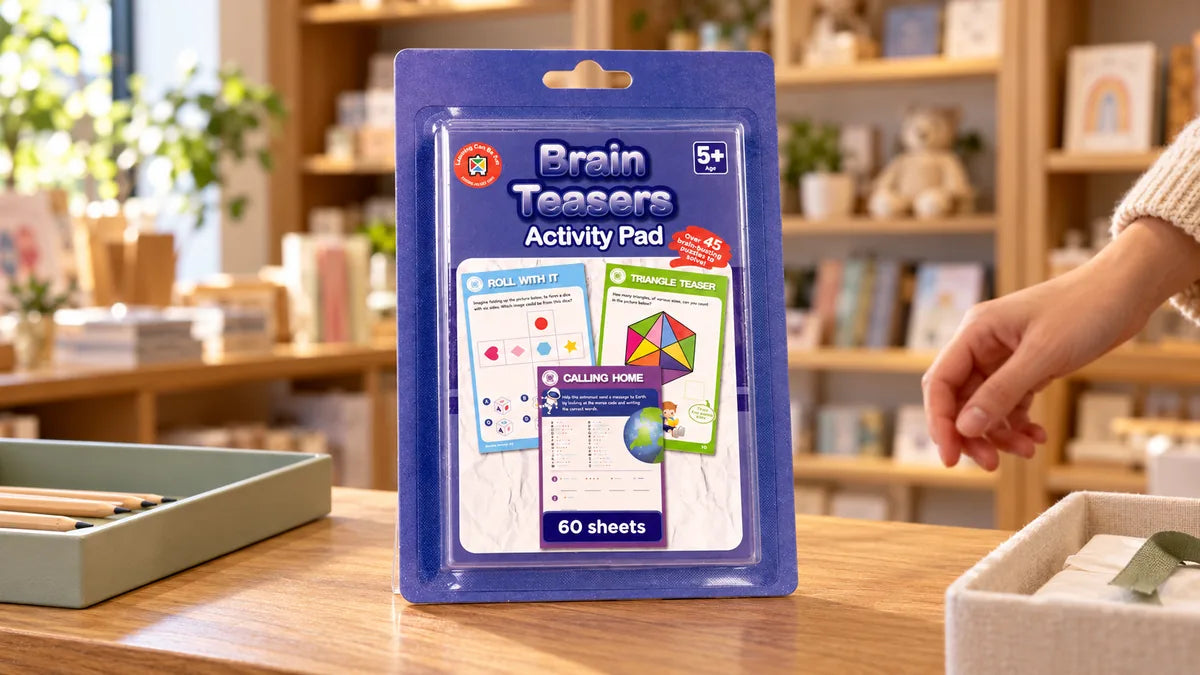
- Pads designed for detachable pages let you offer one activity at a time without handing over a whole book.
- Shared write-in books are less practical unless their reuse is specifically intended and your operating procedures support it.
For example, an appointment-based reception with brief, unpredictable waits could offer an individual activity page and suitable writing tool rather than maintaining a collection of shared games.
Check whether visitors have a comfortable writing surface. A beautifully illustrated pad loses some appeal when someone has to balance it on a knee, a handbag and an increasingly ambitious elbow.
2. Non-electronic drawing boards: best for reusable creative play
A genuinely screen-free drawing board offers something paper cannot: a fresh start without a fresh page. For family-heavy waiting areas, a non-electronic magnetic or mechanical drawing board can support doodling, tracing and simple drawing games without introducing a deck of cards or a pile of puzzle pieces.
Drawing also avoids the need to explain a game before anyone can begin. A child and accompanying adult might take turns adding to a picture, while another visitor may simply prefer to sketch independently. Finishing is optional, which makes the format well suited to interruptions.
It ranks below individual paper activities because it remains a shared item. The drawing surface, stylus, handle and erasing mechanism all need consideration in your cleaning and inspection routine. Erasing a picture resets the activity; it does not clean the board.
When comparing designs, look closely at:
- The board's actual dimensions and whether it fits comfortably on a lap or table.
- The stylus grip and how easily the erasing control moves.
- Any detachable stamps, accessories or other components.
- The manufacturer's age guidance, warnings and care instructions.
If your brief is strictly screen-free, check the construction rather than relying on "reusable drawing board" in the description. An LCD writing tablet is still an electronic display.
Move this category into first place when drawing is likely to appeal to your visitors and your team can manage shared equipment. Move it down when communal items are unsuitable, maintenance is uncertain or the board requires more dexterity than your intended users can comfortably manage.
3. Compact solo puzzles: best for older visitors who want a challenge

Compact puzzles earn third place because they can offer an appealing challenge without requiring conversation or another player. They are particularly worth considering for adult-facing businesses and spaces used by older children, where a shelf of preschool activities would miss the audience.
The strongest waiting-area candidates are self-contained puzzles that remain usable when someone stops halfway through. A manipulation puzzle may need little table space, while a compact tray-based puzzle can keep its components contained. However, those formats have different handling, noise and cleaning requirements.
Difficulty is the main trade-off. A puzzle that looks intriguing to one person can feel like an exam to another. Keep participation optional, avoid presenting it as an intelligence test, and favour instructions that make the objective clear without a staff explanation.
Missing-piece risk also changes the recommendation:
- A self-contained design limits the number of separate components to track.
- A puzzle with loose pieces needs a reliable completeness check.
- A jigsaw needs both a suitable surface and somewhere to preserve or pack away unfinished work.
That last point matters. A communal jigsaw may suit a longer-stay lounge with a dedicated table. It is a weaker choice beside reception forms, payment equipment or a walkway where pieces can migrate.
Inspect the actual design for clicking, rattling or pieces that knock against a hard surface. "Solo" does not automatically mean silent. Nor does "compact" mean simple to clean: grooves, moving parts and material finishes deserve a closer look before purchase.
Choose puzzles when your visitors want a challenge and the room can support it - not merely because the box occupies less shelf space.
4. Card games: best for families waiting together

Card games rank fourth for general reception use because they ask more of the situation. Players need willing company, enough time to understand the rules and somewhere to hold or place their cards. An appointment call may arrive just as the game becomes interesting.
They can still be the strongest option for families or companions expecting a longer wait. A short matching or turn-taking game gives people something to do together, rather than separately occupying the same chairs.
The key distinction is playing within an existing group, not expecting strangers to join in. Nobody should need to recruit the person beside them to make the activity work.
For this setting, favour games with:
- Brief, understandable rules and short, independent rounds.
- Little or no scoring equipment.
- No sound effects, shouting or speed-slapping requirement.
- A manageable number of components and straightforward pack-away.
LatestBuy's family games collection is a useful browsing route for this shared-play approach. Assess each candidate individually: a family-friendly theme does not establish its suitability for a quiet reception area.
Read the full content and instructions, not just the front of the box. Check age guidance, language demands, humour and any prompts that could feel awkward in a professional setting.
Cards also create a reset task. A deck can look tidy while quietly missing the one card that makes the game work. If nobody has time to check completeness, choose a different format. Reception already has enough mysteries.
Let the room change the ranking
The ranking above assumes a general shared waiting area with limited staff involvement. Change those assumptions and the order should change too. A quiet consulting office, a family salon and a vehicle service lounge do not need identical activity shelves.
Use the shortest likely uninterrupted stretch, rather than the longest possible delay, to judge complexity. Visitors may spend much of their wait completing paperwork, speaking with staff or supervising a child. A twenty-minute appointment delay does not necessarily provide twenty minutes of playing time.
| Waiting-area situation | Details |
|---|---|
| Brief, unpredictable waits |
Move this option up: Individual activity pages or booklets The trade-off to accept: Regular replenishment and suitable writing tools |
| Frequent family visits with room to draw |
Move this option up: Non-electronic drawing boards The trade-off to accept: Shared-item cleaning, inspection and access |
| Mostly adults or older children waiting independently |
Move this option up: Compact solo puzzles The trade-off to accept: Difficulty, dexterity and design-specific noise |
| Families or companions expecting longer waits |
Move this option up: Simple card games The trade-off to accept: Rule learning, conversation and deck checks |
| A longer-stay lounge with a dedicated activity table |
Move this option up: Tray-based puzzles or a communal jigsaw The trade-off to accept: Table space, unfinished work and missing pieces |
| A setting that restricts shared objects |
Move this option up: Individual-use paper activities, if permitted The trade-off to accept: Consumable costs and the site's own procedures |
There is no requirement to provide all four categories. One well-chosen activity can be more useful than an impressive assortment that competes with paperwork and occupies every spare surface.
Keep some seating free of activities, too. Screen-free entertainment should be an invitation, not another thing visitors have to navigate.
Make cleaning, access and reset part of the purchase
The purchase decision should include what happens after a visitor puts the activity down. Before ordering, ask someone from reception to walk through the complete cycle: offer it, use it, return it, inspect it, clean it where appropriate and make it ready again.
Manufacturer care instructions and your organisation's procedures should govern cleaning. Do not assume that plastic is disinfectant-compatible, that a coated card can be wiped repeatedly or that a wooden puzzle tolerates the same treatment as a drawing surface. In healthcare settings, confirm whether shared activities are permitted under the practice's infection-prevention procedures before choosing them.
Age suitability requires similar care. Follow warnings and age grading, consider younger siblings as well as intended users, and inspect items for damaged or loose components. A "children's activity corner" sign is not a substitute for an appropriate selection.
Access is practical rather than one-size-fits-all. Consider:
- Clear print, readable instructions and useful visual contrast.
- Whether colour is the only way to distinguish pieces or instructions.
- Grip size, required hand movement and comfortable reach.
- Table height, seated use and room for mobility aids.
- Options that do not rely heavily on reading English.
No single item will meet every preference or access need. Offer different ways to participate where feasible, without claiming universal accessibility.
Finally, try the activity in the actual room while someone answers a phone nearby. Test shuffling, tapping, erasing and pieces landing on the table. A quiet showroom impression can become quite a different soundtrack beside reception's third call of the morning.
Run a small reception trial before buying at scale

Start with a limited trial rather than equipping every waiting area at once. Choose the highest-ranked format that fits your room, plus a contrasting option only if it serves a clearly different visitor need. For instance, individual puzzle pages and a drawing board may reveal more than two similar books.
Give the trial a defined review point-such as after a fortnight or a representative run of busy and quiet sessions. Ask the team to record observations without collecting visitors' personal details:
- Did visitors notice and choose the activity without repeated explanation?
- Could they stop and put it aside promptly when called?
- Did it fit alongside forms, drinks and personal belongings?
- What needed replenishing, repairing, cleaning or checking?
- Did noise or table use interfere with reception work?
- Were particular visitors left without a suitable option?
A capped trial budget helps separate an appealing idea from an ongoing commitment. LatestBuy's under-$30 collection offers a budget-led browsing starting point, but suitability still comes before price. A lower purchase cost is less persuasive if the item creates daily sorting or replacement work.
Compare the ongoing costs as well: paper replenishment, writing tools, damaged components, replacement decks and staff time. Reusable does not mean maintenance-free; consumable does not automatically mean poor value.
Once the trial identifies a workable approach, prepare a focused procurement enquiry. Include your business type, visitor age range, typical waiting pattern, number of locations, available space, budget range and intended quantities. Add any requirements around shared use, materials, care instructions and small components. If there is a required implementation date, state it as a requirement to confirm - not an assumed delivery promise.
Use LatestBuy's Business page to take that brief forward and ask about suitable options. A clear enquiry gives the discussion something useful to work with: not simply "we need activities", but "we need quiet, interruptible activities that fit this room and this routine".
The winning choice is the one visitors enjoy and your team can keep ready for the next person. Interesting enough to pick up, simple enough to put down-that is the waiting-area sweet spot.
For a relevant browse path, compare this with electronics and gadgets.